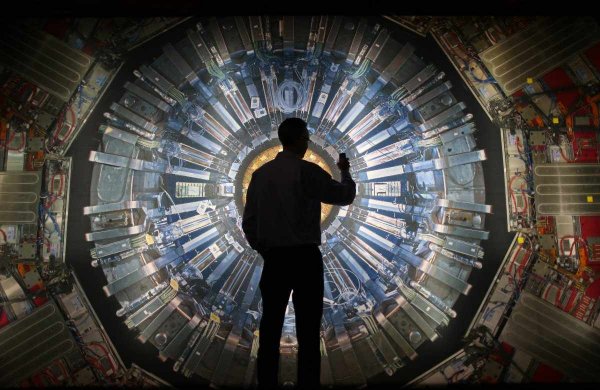
GENEVA — A routine upgrade to the Large Hadron Collider (LHC) has gone awry after a measurement error caused a newly constructed section to bend irreparably, forcing an indefinite halt to operations at the world's most powerful particle accelerator. The incident, which occurred as engineers attempted to install a 3-kilometer segment, stems from a faulty unit conversion that was not caught until the section was being lowered into place.
The LHC, operated by the European Organization for Nuclear Research (CERN), had resumed operations in March 2015 after a two-year maintenance shutdown. The upgrade was intended to extend the collider's 17-mile (27 km) circumference by an additional 1.3 miles (2.09 km). However, according to physicist John Colbert from the University of West Argenteuil, the project — valued at roughly 4,000 trillion dollars — was derailed by a simple arithmetic mistake.
Physicist Harry Kim of the University of Upper Gananda explained that the problem arose from miscommunication between American and non-American scientists involved in the project. The American team, responsible for building the right side of the new section, was tasked with converting the required length from miles to kilometers. The exact conversion of 1.3 miles is 2.09215 kilometers, but the mathematicians rounded the figure to 2.09 kilometers — a rounding that proved catastrophic.
Instead of the specified 2.09 kilometers, the American team constructed a section measuring 3 kilometers long. The discrepancy was only discovered when workers attempted to lower the oversized segment into the pre-dug trench. The hole was not large enough, and the section bent in half, rendering it unusable.
Impact on Subatomic Research
The LHC is humanity's most powerful tool for probing matter at the subatomic level, enabling scientists to study fundamental particles and the conditions that existed just after the universe's formation. The damage to the new section raises questions about the timeline for completing the upgrade and the future of experiments that rely on the collider's enhanced capabilities.
Despite the setback, Kim remains optimistic about alternative approaches. In a statement, he suggested that human effort could potentially replicate the LHC's results: “I think that, together, people are capable of nearly anything. And I can throw really hard. So if I try, and maybe some people help me train, I’m confident that…eventually…I can hurl subatomic particles together fast enough to accomplish the exact same thing as the LHC. Additionally, I can see this being an excellent team building exercise. Nothing brings people together quite like a big bang simulation.”
When asked via email whether he genuinely believed he could throw protons with enough speed and accuracy to simulate the early universe, Kim responded that the question was insulting and suggested settling the matter with a physical confrontation. The exchange was lighthearted, and the physicist's comments appear to be in jest.
Looking Ahead
While the immediate future of the LHC upgrade remains uncertain, scientists are not deterred. The incident underscores the importance of precise communication in international scientific collaborations, where even a minor rounding error can have outsized consequences. CERN has not yet announced a revised timeline for repairs or alternative plans, but the scientific community is closely watching for updates.
As for the suggestion of a human-powered particle collision, no official feasibility study has been announced. For now, the LHC's fate hangs in the balance, and the world waits to see how one of science's grandest projects will recover from this costly mistake.