In a New Year's Day announcement, researchers at China's Experimental Advanced Superconducting Tokamak (EAST) reported achieving plasma densities that exceed a long-standing theoretical boundary, marking a significant advance in the quest for practical fusion energy. The findings, published in the journal Science Advances, describe a method that pushes the limits of what was previously considered possible in nuclear fusion.
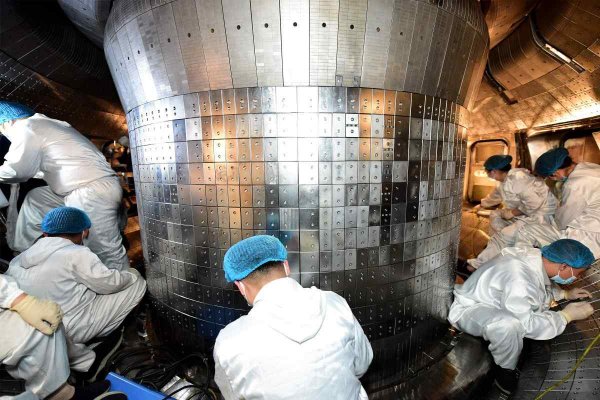
The EAST facility, located at the Hefei Institutes of Physical Science under the Chinese Academy of Sciences, is often referred to as China's "artificial sun" due to its role in mimicking the solar process of fusion. The team's work, led by scientists including plasma physicist Ping Zhu from Huazhong University of Science and Technology, demonstrates a way to stabilize plasma at densities that surpass the Greenwald limit—a threshold that predicts instability when density rises too high.
Nuclear fusion, the process that powers stars, involves combining atomic nuclei to release energy. On Earth, achieving this requires heating fuel to extreme temperatures—around 150 million kelvin (27 million degrees Fahrenheit)—to create a plasma state where nuclei can overcome their natural repulsion. However, maintaining a stable, dense plasma for sustained reactions has been a major hurdle.
The Greenwald limit, named after MIT physicist Martin Greenwald, has long been a benchmark in fusion research. It posits that exceeding a certain density leads to plasma disruptions, which can damage reactor walls and halt the reaction. The EAST team's approach, as detailed in their study, involves creating a high-pressure gas environment before plasma formation, which reduces the destructive interaction between plasma and reactor walls. Additionally, they inject extra energy during heating to allow a gradual density increase, resulting in a stable plasma that exceeds previous empirical limits.
Zhu noted that the findings "suggest a practical and scalable pathway for extending density limits in tokamaks and next generation burning plasma fusion devices." This is a crucial step for future reactors like ITER, which aim to demonstrate net energy gain.
Implications for Fusion Energy
While commercial fusion power remains a distant goal, breaking the Greenwald limit addresses a key technical challenge. The ability to maintain high-density plasma is essential for achieving a self-sustaining reaction, where the energy produced exceeds that required to maintain the reaction. This breakthrough adds to China's growing portfolio in green energy technologies, which includes significant investments in solar, wind, and now fusion research.
The EAST team's success is not just a national achievement but a global one, as fusion research is an international endeavor. The findings offer a new avenue for other tokamak projects to explore, potentially accelerating progress toward a clean, virtually limitless energy source.
As the world grapples with climate change and energy security, advances like this are more than scientific curiosities; they are steps toward a future where energy is abundant and emission-free. However, experts caution that many hurdles remain, including achieving sustained reactions and developing materials that can withstand the intense conditions inside a fusion reactor.
The study's publication in a peer-reviewed journal underscores the credibility of the research, and the international community will be watching closely to see if these results can be replicated and scaled.