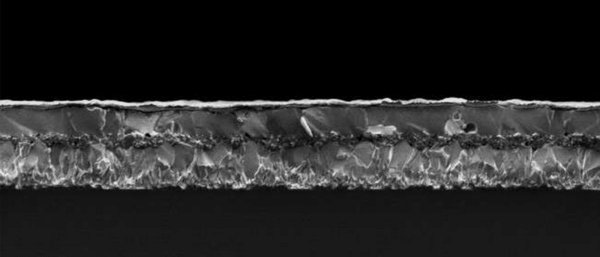
Researchers at the Swiss Federal Institute of Technology in Lausanne (EPFL) have reported a significant advance in solar cell technology, achieving a record conversion efficiency of 21.6 percent by incorporating rubidium into perovskite solar cells. The findings, published in the journal Science, mark a step toward more stable and commercially viable photovoltaic devices.
The new cells, developed in the laboratory of Michael Grätzel, maintain their performance for more than 500 hours of continuous operation under full sunlight at 85°C (185°F). According to the research team, the cells also exhibit what they describe as "record-level reproducibility," a factor critical for large-scale manufacturing.
Perovskite solar cells are a relatively recent innovation that combines a silicon layer with a crystal structure of calcium titanium oxide to harvest sunlight. The EPFL team's modification involves embedding rubidium cations into the cell, a soft metallic element that enhances the material's properties.
This work builds on earlier efforts this year when the same group developed perovskite cells with cesium, which reached 20.2 percent efficiency but only remained stable at temperatures above 300°C (572°F). The rubidium-integrated cells not only improve efficiency but also provide a voltage close to the "thermodynamic limit," the theoretical maximum for converting sunlight into electricity.
Michael Saliba, one of the study's leaders, called the achievement "an absolute breakthrough," emphasizing that the properties are crucial for commercializing perovskite photovoltaics. "Reproducibility and stability are the main requirements for cost-effective large-scale manufacturing," he said.
EPFL has filed a patent application for the new cells, suggesting potential near-term industrial application. The technology could accelerate the adoption of renewable energy by offering a more efficient and durable alternative to conventional silicon-based panels.
While the laboratory results are promising, experts caution that scaling up from lab tests to commercial production involves additional challenges, including cost and long-term performance validation. Nonetheless, the EPFL breakthrough represents a tangible step forward in the quest for more reliable solar energy solutions.