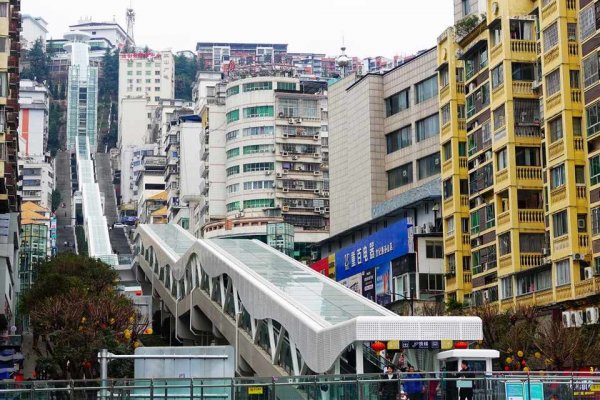
WUSHAN, China — A new outdoor escalator stretching more than half a mile has begun carrying passengers up a steep hillside in the mountainous Chongqing municipality, offering a 21-minute ascent that locals say transforms daily commutes and errands.
The so-called “Goddess” escalator, which opened in the city of Wushan, is composed of roughly two dozen individual escalators and lifts that operate as a single system. It starts at the base of a steep bank and climbs toward the sky, a design that its creators say has no parallel in the country.
“As far as I know, there are no similar projects nationwide, either exceeding or equal to ours, either under construction or already started,” Huang Wei, head of the design team and an engineer at China Railway Eryuan Engineering Group, told the Financial Times. “It’s the first of its kind.”
The system’s stairways were produced by the Swiss company Schindler and manufactured in a factory north of Shanghai. The company’s Chinese arm has supplied about 1,400 escalators to the Chongqing metro system, according to the FT report.
Local officials say the escalator has quickly become a popular fixture. About 9,000 people use it daily, paying roughly $0.43 per ride in one direction. During the Spring Festival last month, an official said, 450,000 people used the system.
For many residents, the escalator is more than a novelty. Xie Hongmin, a 44-year-old visiting from a nearby rural settlement, said he hoped his own town would install something similar. “Walking is quite tiring,” he told the FT.
The system also eases the work of the city’s “bangbang men,” porters who carry goods on bamboo poles or haul bulky boxes on their backs. Ran Guanghui, a 60-year-old porter, used the escalator to carry bags of bras into a nearby mall. “In the 1990s, there were probably tens of thousands of porters in Yuzhong district alone,” he said. “There weren’t elevators before, which was quite inconvenient.”
The Goddess escalator joins the city’s iconic Crown escalator, built in the 1990s, as a symbol of Chongqing’s ambitious infrastructure. The region’s steep terrain has long posed challenges for pedestrians, and such vertical transit projects aim to ease mobility.
While the escalator’s scale is unusual, it reflects a broader trend in Chinese cities to invest in large-scale public works. The project’s designers say the system is tailored to Wushan’s geography, where conventional roads are impractical.
As the escalator gains attention, it underscores how urban planners are adapting to mountainous landscapes. For now, it stands as a practical solution for a community that has long contended with steep slopes.