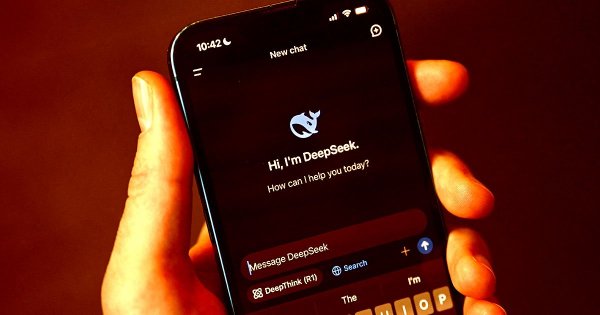
Senator Josh Hawley (R-MO) has introduced legislation that would make it a federal crime for Americans to use or import DeepSeek, the Chinese AI chatbot that rattled markets last week, with penalties including up to 20 years in prison and fines reaching $1 million for individuals and $100 million for companies.
The bill, filed last week, aims to "prohibit United States persons from advancing artificial intelligence capabilities within the People's Republic of China," according to its text. Harvard AI research fellow Ben Brooks described it as "easily the most aggressive legislative action on AI," underscoring the severity of the proposed measures.
Under the bill, anyone found importing "technology or intellectual property" developed in China could face the maximum prison sentence and fines. The proposal comes amid a wave of concern among lawmakers following DeepSeek's rapid rise and the massive selloff it triggered on Wall Street, which erased more than $1 trillion in market value from US tech stocks.
Hawley's bill, however, was tabled last week—a procedural move that often signals a bill has lost momentum. Despite the setback, the legislation highlights a growing bipartisan push to curb China's access to US AI technology. Hawley and Senator Elizabeth Warren (D-MA) have jointly argued that the Biden administration was too slow to implement export controls on AI chips, which began in 2022.
"Multiple administrations have failed—at the behest of corporate interests—to update and enforce our export controls in a timely manner," the two senators wrote in an appeal to Congress obtained by The Washington Post. "We cannot let that continue."
DeepSeek's breakthrough earlier this month demonstrated that AI performance comparable to OpenAI's leading chatbots can be achieved using a fraction of the resources, raising doubts about whether US tech companies are overvalued. Lawmakers are now weighing national security risks against market interests, with some calling for stricter limits on Chinese companies' access to Nvidia's advanced chips.
Nvidia CEO Jensen Huang met with President Donald Trump on Friday, just days after the company suffered the largest single-day loss in its history. A spokesperson told Reuters that the meeting focused on "the importance of strengthening US technology and AI leadership." Trump offered no specifics, telling reporters, "I can't say what's gonna happen. We had a meeting. It was a good meeting."
Political and Market Implications
The proposal faces significant hurdles. The ongoing TikTok saga—a ban passed by Congress last year but stalled due to Trump's opposition—illustrates the complexities of legislating national security concerns around Chinese tech. Whether DeepSeek poses a similar risk, or whether lawmakers are protecting US market interests, remains an open question. Some legislators have personal financial stakes in the outcome, adding another layer of complexity.
As the debate continues, the bill serves as a marker of the heightened tensions in US-China tech relations, with both parties seeking to assert control over the rapidly evolving AI landscape.